

What Hunters Should Know Before Taking an E-Bike Into the Backcountry
An e-bike can make backcountry hunting easier by reducing the effort required to cover long access roads, climb hills and move gear between camp and hunting areas. But once the pavement ends, motor power is only part of the equation.
Range matters more when there is no convenient place to recharge. Tires and suspension matter when a smooth road turns into loose gravel, mud or roots. Weight becomes important when the bike has to be pushed around an obstacle. And a mechanical problem that would be an inconvenience near home can become a serious problem several miles into the woods.
For hunters, the right e-bike is not simply a fast bicycle with a motor. It is another piece of backcountry equipment, and it needs to be planned around the terrain, distance, load and route rules before the trip begins.
Why Are Hunters Using E-Bikes in the Backcountry?
The biggest advantage is access.
Hunting often involves covering considerable distance before the actual hunt begins. Forest roads, farm tracks and long approaches can consume time and energy, particularly when the route includes elevation or when the rider is carrying equipment.
An e-bike can reduce some of that effort while remaining considerably smaller than an ATV or other off-road vehicle. That makes it useful in situations where the route is suitable and e-bike access is permitted.
The benefit becomes clearer on the return journey. The trip back to camp may happen after hours outdoors, with less energy than the rider had in the morning and potentially more equipment to carry.
That is why hunters should think about the entire route rather than just how easily the bike reaches the destination.
If a trail is eight miles into the backcountry, the important number is not eight miles. It is at least sixteen, plus scouting, detours and a reasonable battery reserve.
How Much Battery Range Does a Hunting E-Bike Need?
A hunting ebike needs enough usable battery capacity to complete the entire route with reserve power left over.
Published range numbers can provide a useful reference, but backcountry conditions are rarely ideal. Steep climbs, soft soil, cold temperatures, rider weight, cargo and high assistance levels can all increase the amount of energy used.
A hunter riding ten miles on flat pavement should not assume that ten miles of climbing on an unpaved forest road will use the same amount of battery.
Plan conservatively.
Start with the expected round-trip distance, account for elevation and terrain, then leave additional capacity for route changes. Turning around early because battery use is higher than expected is much easier than trying to move a heavy e-bike several miles through the woods without assistance.
A removable battery can also make charging and storage easier around camp, but it does not replace careful route planning.
The farther the ride moves from roads and reliable communication, the less sensible it becomes to treat the maximum advertised range as a target.
How Much Motor Power Is Actually Useful?
More motor power can help when the bike is carrying extra weight or climbing loose, steep terrain, but the goal should be controlled traction rather than maximum acceleration.
A stronger motor can reduce the effort required on long climbs. Dual-motor systems can provide assistance at both wheels, which may be useful when traction changes across gravel, dirt or loose surfaces.
That does not mean the most powerful electric bike is automatically the best hunting bike.
Higher output can use more battery when ridden aggressively, while additional motors and larger components can increase overall bike weight. Backcountry riders need to balance power against range, handling and the possibility that the bike may eventually need to be maneuvered without motor assistance.
Power is most valuable when it helps the rider maintain control and keep moving through difficult sections—not when it simply produces the largest specification on the product page.
What Does a Backcountry-Oriented E-Bike Look Like?
A useful hunting setup combines traction, battery capacity and load support rather than relying on one headline specification.
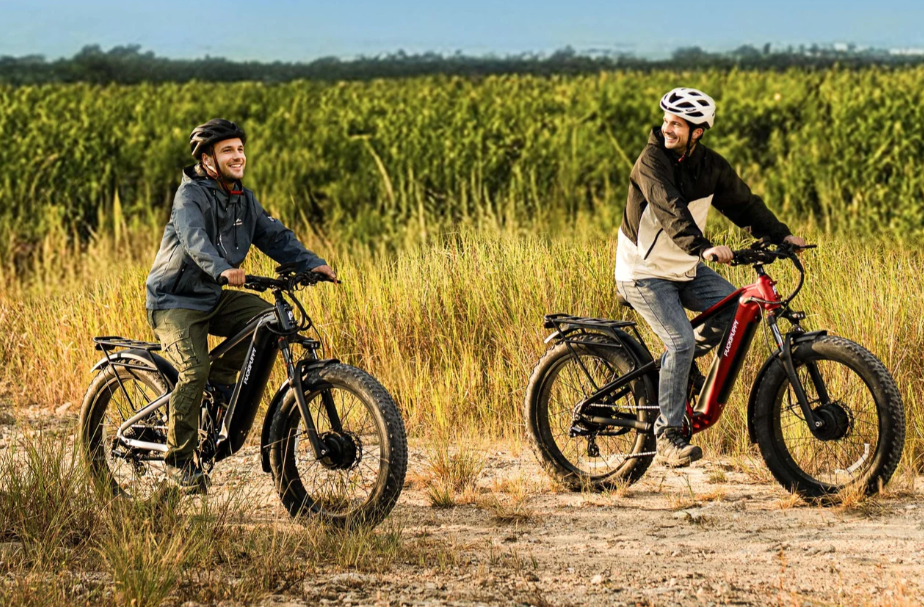
The Puckipuppy GoldenR Pro is one example of an electric hunting bike built around that idea. It uses front and rear motors with 1,100W rated output and 1,600W peak output, along with a removable 48V 20Ah battery rated for 40 to 80 miles depending on riding conditions. Its 26-by-4-inch fat tires, full suspension and 400-pound maximum load capacity are relevant for riders carrying equipment across gravel roads, wooded routes and other uneven terrain. Puckipuppy also lists hydraulic disc brakes and a torque-and-cadence sensor, which help make the bike's power easier to manage across changing conditions.
There is a trade-off. The GoldenR Pro weighs 92.6 pounds.
That is exactly the kind of number hunters should pay attention to before going deep into the backcountry. A powerful bike can make the ride easier, but if a fallen tree, washed-out trail or mechanical failure requires the bike to be lifted or pushed, its weight becomes very real.
Why Do Fat Tires Matter on Hunting Routes?
Fat tires are useful because backcountry routes rarely stay consistent.
A forest road may begin hard-packed and dry, then turn loose after a storm. Grass, gravel, sand and muddy sections can all appear on the same route.
Wider tires provide a larger contact area and can give riders more confidence when traction is inconsistent. They can also help a loaded bike feel more stable on rough surfaces.
But fat tires are not a substitute for good route judgment.
Deep mud can stop almost any bicycle. Wet roots can be slippery regardless of tire width. Loose descents still require careful braking and body positioning.
Tire pressure also matters. Riders should check pressure before leaving camp and carry equipment that can handle a puncture or pressure loss in the field.
Infolific's own bicycling guidance makes the same practical point about ride preparation: cyclists should be prepared to repair a flat rather than assuming one will not happen.
That advice becomes even more important when the nearest road is miles away.
Does Suspension Matter in the Backcountry?
Suspension becomes more useful as the route becomes rougher and the ride becomes longer.
Tree roots, rocks, ruts and repeated washboard surfaces create fatigue long before they make a route completely impassable. Front suspension helps reduce impacts reaching the handlebars, while rear suspension can make longer stretches of uneven terrain easier on the rider.
The benefit is not simply comfort.
A rider who is less fatigued may be better able to maintain control late in the day. That matters on descents and rough sections when attention is already divided between the route, equipment and changing conditions.
There is still a cost. Suspension adds weight and moving parts, so hunters riding mainly smooth access roads may not need a complicated setup.
The terrain should decide the equipment.
How Much Carrying Capacity Is Enough?
For hunters comparing an electric bike for adults, payload capacity should account for the rider and everything carried or attached to the bike.
That includes clothing, water, backpack, tools, hunting equipment and any cargo carried on racks or trailers. A 400-pound load rating does not mean a rider can simply add 400 pounds of gear.
The rider is already part of that number.
Hunters should calculate their expected total load before the season rather than on the morning of a trip. Extra weight also changes the way the bike accelerates, climbs and brakes.
Cargo placement matters as well.
Heavy items mounted high or far behind the rear wheel can change handling. Keep loads secure and balanced, and test the complete setup close to home before taking it onto a remote route.
A bike that feels stable and unloaded may behave differently with a full day's equipment attached.
What Happens If the Battery Runs Out?
The bike still needs to be rideable—or at least movable.
This is one of the most important differences between backcountry use and ordinary recreational riding. Near home, a depleted battery might mean an inconvenient pedal back or a phone call for help.
In the woods, those options may not exist.
Heavy e-bikes can be difficult to pedal without assistance, especially uphill. Riders should understand how the bike behaves with the motor turned off before depending on it deep in the backcountry.
Try riding it without assistance during training rides.
Know the gearing. Know how far it can reasonably be pedaled under human power. If the answer is “not very far,” that should influence how much battery reserve is maintained during the hunt.
Backcountry planning works best when electricity is treated as a useful resource rather than a guarantee.
What Repair Gear Should Hunters Carry?
At minimum, carry equipment for the failures that can realistically be repaired in the field.
That may include a pump, tire plugs or patches appropriate for the tire system, basic hand tools, spare fasteners and anything specifically required by the bike.
A compact repair kit should be accessible without unloading everything else.
Before leaving, inspect the tires, brakes, chain, battery connection and cargo mounts. Check that bolts are secure and confirm that anything attached to a rack cannot shift into the wheel.
More complicated electrical failures may not be repairable beside the trail. The practical response is preparation: know the bike, maintain it before the trip and keep enough margin in the route plan to deal with an unexpected stop.
Infolific's wilderness survival section describes survival as a continuing series of problems that need to be addressed rather than a single dramatic event.
That is a useful way to think about backcountry equipment as well. Small problems are easier to manage before they combine.
Can You Ride a Hunting E-Bike Anywhere a Bicycle Can Go?
No. Hunters should confirm e-bike access for the specific road or trail before riding.
Rules differ among states, public-land agencies and individual land-management areas. On U.S. Forest Service lands, e-bikes remain classified as motor vehicles under current federal guidance, although local managers can designate particular roads and trails for e-bike access. Department of the Interior agencies also manage access through agency and local land-management decisions.
That means a trail open to a conventional mountain bike should not automatically be assumed to permit an e-bike.
Check the managing agency's current map and regulations before the trip. Hunting regulations and motorized-access restrictions may create additional requirements depending on the location.
The fastest way to create trouble in the backcountry is to assume that access rules are the same everywhere.
What Should You Check Before Leaving Camp?
Do the boring checks while the truck, tools and charger are still nearby.
Confirm battery charge, tire pressure and brake operation. Make sure racks and cargo are secure. Check the route distance and weather. Carry water, navigation tools and basic repair equipment.
Then look at the return plan.
How much climbing is involved on the way back? What happens if a planned road is closed? How much battery reserve will remain? Can the bike be pedaled or pushed if assistance is lost?
Those questions matter more than maximum speed.
A backcountry e-bike should increase the margin for exploration, not encourage riders to remove their margin for error.
Treat the E-Bike Like Backcountry Equipment
Hunters already understand that equipment is only useful when it works with the environment.
Boots need to match the terrain. Clothing needs to match the weather. Water and food need to match the duration of the trip.
An e-bike should be evaluated the same way.
Choose enough battery for the complete route, enough traction for the surface and enough carrying capacity for the real load. Bring repair equipment, understand what happens when the motor is unavailable and confirm that the route is legally open to e-bike use.
Extra power can make difficult terrain easier. It cannot replace preparation.
The best backcountry ride is not the one that gets deepest into the woods. It is the one that still leaves a reliable way back out.
839GYLCCC1992

Leave a Reply