

Inside a Live Casino Studio: How One Roulette Table Streams to Thousands of Players at Once
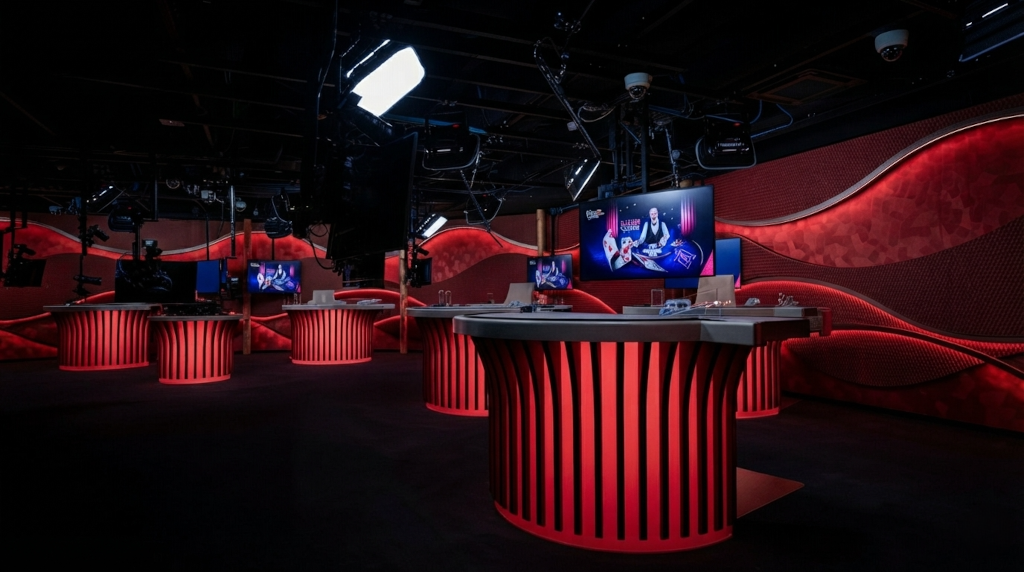
A roulette ball drops into pocket 17 in a soundproofed room in Riga, Latvia. Less than two seconds later, the same moment plays out on a phone in Toronto, a laptop in Sao Paulo, a tablet in Tbilisi, and a smart TV in Manchester. Live dealer gaming started as a fairly clunky experiment in the mid-2000s, with grainy video and long delays. Today it's one of the biggest parts of online casino play, and the setup behind each spin is a lot more involved than a camera pointed at a wheel.
The company most people link with this format is Evolution, founded in Sweden in 2006 and listed on Nasdaq Stockholm. It reported operating revenue of roughly EUR 2.2 billion for 2024, and live casino made up the large majority of that figure.
Anyone browsing the Evolution Gaming section at BetFury will find dozens of roulette tables running around the clock, from classic European wheels to multiplier games. Very few players ever think about the rooms those tables sit in, or the people working behind the glass. But the studio is where the real work happens. And it runs more like a TV station than a casino floor.
What a Live Casino Studio Actually Looks Like
Walk into a large live studio and the first thing you'd notice is the quiet. The floor is split into dozens of small booths, each one a self-contained set with its own table, lighting rig, backdrop, and cameras. A dealer might be spinning a wheel three meters from another dealer running blackjack, yet neither table's microphone picks up the other. Acoustic panels, carpet, and directional mics handle most of that. The Riga facility is often cited as one of the largest in the world, with hundreds of tables spread across several floors, and the company also runs studios in places like Malta, Georgia, Canada, and several U.S. states where local law requires games to be streamed from inside the state.
It looks a bit like a film lot shrunk down. Lots of cables.
The Dealer's Booth
The dealer works facing the main camera, usually standing, and talks to a chat window shown on a monitor just off-screen. Dealers are trained to read player messages aloud, greet regulars by username, and keep up a steady patter during the betting window. Shifts are split into rotations, so a single table might see several dealers in an hour (this keeps fatigue down and probably helps with fairness checks, too). In some studios dealers work in a few languages, and a table aimed at Spanish-speaking players will have a dealer who speaks Spanish on camera.
Behind the Glass
Pit bosses and shift managers sit out of frame, watching several tables at once on a wall of screens. They step in when a ball jumps the track or a card is misread.
How the Roulette Wheel Talks to the Software
This is the part most players never see. A live roulette wheel isn't just a wheel. It's a sensor-packed machine that reports every result in real time.
Professional wheels from makers such as Cammegh and TCS John Huxley have been fitted with automated reading systems for years. When the ball settles, sensors identify the winning pocket and pass that data to a device often called a Game Control Unit. That unit translates the physical result into a digital one the betting platform can understand. Optical character recognition (OCR) plays a similar part at card tables, reading the suits and values on screen.
A single round, from the platform's side, roughly goes like this:
- The betting window opens and the software starts accepting wagers from every connected player.
- Bets close, usually with a countdown shown on screen.
- The dealer spins the wheel and launches the ball in the opposite direction.
- Sensors register the winning number, the Game Control Unit confirms it, and the result is sent to the platform, which settles every bet at once and updates thousands of balances within a moment or two.
So the video and the result travel on separate paths. The stream is what you watch. The data feed is what actually pays you.
The Camera Setup Behind Every Spin
Most roulette tables use several cameras. One wide shot shows the dealer and table, another tracks the wheel from above, and a close-up catches the ball as it slows down. Software cuts between them automatically, which is why the view jumps to the wheel just as the ball starts to drop. Some premium tables add slow-motion replays of the final bounce.
Lighting is tuned for cameras, not people. That's why the studio can look oddly bright in person (one visitor described it as “standing inside a fridge with the door open”) while appearing warm and natural on screen.
How One Stream Reaches Thousands of Players
Here's where the scale comes in. A busy roulette table might have thousands of players watching at the same time, yet the studio only produces one video feed. How does that work without the whole thing collapsing?
The answer is fairly old-school broadcasting, updated for the internet. The raw video is encoded on site, then pushed to a content delivery network, which copies it to servers in many regions. A player in Brazil pulls the stream from a server near Brazil, not from Latvia directly. Adaptive bitrate streaming adjusts the picture quality to each player's connection, so someone on weak mobile data gets a lower-resolution picture rather than a frozen one. Delay is usually kept to a few seconds at most.
An airport departure board is a decent comparison. One board, hundreds of travelers, and each person reads it for their own flight. The roulette stream is the board. Your bet is your ticket, handled privately by the platform's servers.
Why There's No Seat Limit
A real casino roulette table fits maybe seven or eight players before things get crowded. Online, the wheel doesn't care. Since every bet is just data, there's no physical cap, and a single table can take wagers from a huge crowd without slowing down.
Blackjack is harder, since each seat gets its own cards. That's partly why formats like Infinite Blackjack were built, letting unlimited players share one starting hand and then make their own decisions.
Bet Windows and Timing
Timing is tight. Betting windows on standard live roulette tend to run somewhere around 15 to 20 seconds, though this varies by table and variant. Studios seem to aim for a pace of very roughly 40 to 60 rounds per hour on a classic table, while faster “speed” versions cut the wait between spins.
Keeping the Game Fair and Licensed
Live tables don't use a random number generator for the outcome. The physics of the ball does the work. But physical wheels can wear unevenly, which is why studios check and rotate them regularly and log results to spot any statistical bias.
Regulators keep a close eye on all of this. Bodies like the Malta Gaming Authority and the UK Gambling Commission license studios and require audits, surveillance recording, and clear procedures for errors. If a ball leaves the wheel or a sensor fails, the round is usually declared void and bets are returned.
The math stays the same as in a land-based casino. A single-zero European wheel has 37 pockets, giving the house an edge of about 2.7% on most bets. A double-zero American wheel has 38 pockets, which pushes the edge to roughly 5.26%.
What Players Notice (and What They Don't)
Anyone who has played a fair amount of live roulette probably remembers the first time a stream stuttered right as the ball was dropping. It's a nervy few seconds. But the bet still counts, because the result comes from the wheel sensors and not from what your screen showed. Most platforms keep a round history you can check afterward.
Game shows have pushed the format further. Lightning Roulette, launched by Evolution in 2018, adds random multipliers from 50x to 500x on selected numbers, mixing a real wheel with graphics layered on top. And some newer titles use green-screen sets, so the dealer stands in front of a backdrop that's added digitally. Is it still a “real” casino if half the room is computer-generated? Players don't seem to mind, judging by how busy those tables get.
A few small things experienced players tend to pick up over time:
- The countdown timer matters more than the dealer's voice.
- Lower video quality saves data and doesn't change the odds.
- Checking which wheel type you're on (single-zero or double-zero) takes two seconds and noticeably changes the house edge over a long session.
- Chat is moderated, and dealers can't help with account issues, so support questions go to the platform rather than the table.
Then there's the human side, which no amount of fiber optic cable can fake. A dealer in Riga wishing a player in Montreal a happy birthday, on a stream that thousands of strangers are watching at the same moment. That's the strange little trick live casino pulls off every few minutes, all day, every day.
839GYLCCC1992

Leave a Reply