

8 Simple Steps To Run Your Own Business as an Electrician
Running your own electrical business requires a specific sequence of credentials, legal steps, and operational systems, and the order matters as much as the individual actions. Being the most capable person on a crew and knowing how to charge for that work under your own name are two different skills.
Many experienced electricians stay employed for years not because they lack ability, but because no one has laid out the full route from logged apprenticeship hours to a functioning business with paying clients. Here it is, in the order it actually happens.
1. Log and Verify Your Apprenticeship Hours
Your hour count acts as the first hard gate. Every milestone depends on documented hours, since states require an attainment of 8,000 hours of on-the-job learning for journeyman eligibility. Boards demand these totals be broken down, so you must track residential, commercial, and industrial hours separately.
Assuming a program tracks everything accurately without verification creates delays, so check employer sign-offs and logs periodically throughout your apprenticeship. Waiting makes discrepancies difficult to correct, meaning you should compare your records against the official tally every few months.
| Important: Don't assume your apprenticeship program is tracking your hours accurately. Verify employer sign-offs and your own logs periodically; discrepancies discovered at the end are far harder to correct. |
2. Pass the Journeyman Exam First Time
NEC-based journeyman exams are timed, code-referenced, and calculation-heavy. Test-day performance diverges from field knowledge because the format introduces new variables. Code-lookup speed matters immensely, separating a passing score from a failure.
Finding out where you stand before booking a date saves money, because early gaps remain closable. Taking Dakota Prep's AI-guided journeyman electrician practice test early exposes weak points while time remains to fix them. This platform features thousands of NEC practice questions alongside an AI tutor.
Once you identify weak NEC articles, build a study plan around those specific areas. Targeted drilling consistently proves more efficient than broad reviews.
| Pro Tip: Run a free journeyman practice exam early to surface weak NEC areas and close them before test day. Targeted drilling on gaps beats broad review. |
3. Plan Time for the Master License
The journeyman card gets you in, while the master license lets you run the job. Candidates must complete two to four years of field experience before sitting for the master exam. The test itself goes deeper into load calculations and complex code interpretation.
A master license is required to pull permits, making it mandatory for independent operators while providing a waiting window to build your foundation. Use that window to establish your legal structure and insurance policies.
4. Choose Business Structure and Proper Insurance
Operating as a sole proprietor is fast, but an LLC creates necessary liability separation that matters the moment something goes wrong onsite. You need an Employer Identification Number from the IRS, which takes minutes online. Commercial clients require proof of this tax number before issuing contracts.
General liability coverage requirements vary by state, with places like Texas demanding at least $300,000 per occurrence and a $600,000 aggregate. Workers' compensation becomes mandatory once you hire an employee. New operators frequently under-buy tools and equipment insurance, and because personal auto policies exclude business use, vehicles are often left uninsured during job commutes.
5. Price Work to Cover Your Overhead
Charging for labor only stands out as the most common pricing mistake since your final rate must carry drive time, material markup, and a profit margin. A true hourly rate starts with your target wage before adding fixed overhead items, which you then divide by realistic billable hours. Research shows that construction overhead and profit margins typically range from 20 to 40 percent of total project costs.
Van time and drive time cost money, so build them into the rate explicitly alongside standard material markups of fifteen to twenty-five percent. Flat-rate pricing works well for predictable residential tasks, while time-and-materials billing fits commercial work where variables are harder to estimate. Avoid matching competitor pricing blindly because their operating expenses might be significantly lower.
| Key Insight: A true hourly rate starts with your target wage, adds fixed overhead like insurance and tools, then divides by realistic billable hours per week, not total hours worked. |
6. Look Like a Real Business Immediately
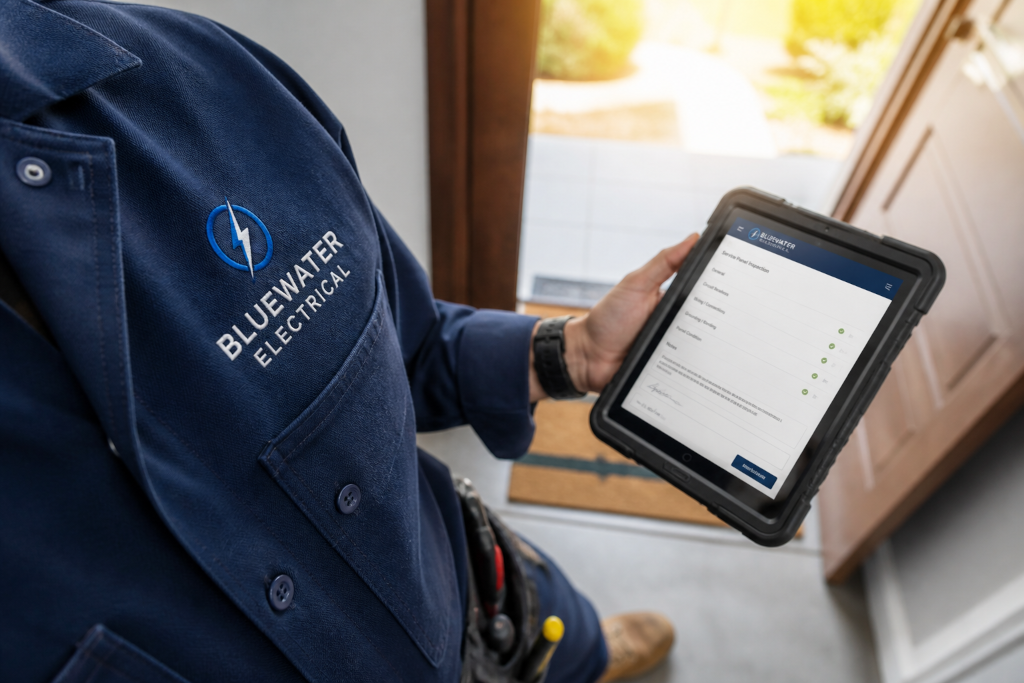
The first impression on a domestic job happens at the door before you open a single panel. Two crews bidding the same job send different signals if one wears branded shirts while the other wears streetwear. Branded work apparel serves as a low-cost credibility investment, so ordering custom t-shirts for staff from Swagprint.com before the first job ensures your presentation stays consistent.
Fabric weight matters significantly when selecting gear, with heavier cotton or poly-cotton blends holding up much better than thin promotional fabrics. Size the order to cover anyone you bring onsite, including subcontractors, because unbranded crew members undercut your image. Keep the logo clean and avoid intricate details so your business name prints clearly at standard sizes.
| Quote: Two crews bidding the same job, one in branded shirts, one in mixed streetwear, present two different signals about which operator takes the work seriously. |
7. Win First Jobs Through Trade Contacts
Paid advertising rewards businesses that already have volume behind them, meaning your first jobs will come from people who know your work quality firsthand. Start by tapping into former employers, site inspectors, and electrical suppliers. Adjacent trades like plumbers and HVAC contractors trade referrals regularly, and local directories offer low-cost visibility that carries more weight than cold ads.
You need to turn every completed project into a reliable reference by following up directly and asking for a review with a text link to your business page. Never buy leads before having the internal systems to handle them properly. Wasted leads cost money to purchase and damage your reputation when follow-ups fail.
8. Build Back-End Systems Before Needed
Administrative chaos kills momentum faster than a slow market, so setting up invoicing and job management software from day one establishes solid operational habits. Even basic software creates a paper trail that protects your business during disputes. Written and itemized quotes signed before work begins are completely non-negotiable since verbal agreements invite unresolvable financial disputes.
Send invoices upon completion or at agreed milestones rather than waiting indefinitely. Setting payment terms upfront prevents surprises, with net seven or fourteen days being standard residentially. You also need to know the commercial standards in your area before submitting quotes, and follow up on late payments using a scheduled system.
The Path Forward
Logged hours grant access to the journeyman exam, where proper study preparation determines success. Holding that card starts the clock on master license eligibility. Earning the master license ultimately secures your ability to pull permits.
You can use the master license waiting period to establish your legal structure, lock down insurance, and set a pricing model. Ordering professional branded workwear early ensures crew consistency from day one, while implementing back-end quoting systems prepares the operation before volume arrives.
839GYLCCC1992

Leave a Reply