

Breeding Chinchillas – Development of the Young
Table of Contents
In this third and final article in the series of breeding chinchillas, we look at raising newborn chinchillas.
The First Hours
Right after birth the fully developed and instinctively intelligent baby will crawl under its mother's body, where both her body heat and licking dry it. Soon the kit will be making whimpering noises and mom may gently nip the back of its neck, as may other cage mates. Even though the kit may now squeal louder this is usually just healthy socialization and you'll continue to hear this “don't-hurt-me” noise until the kit is a young adult. Be sure to observe the relationships among the newly restructured family to be sure that no chinchillas in the cage pose a threat to the kits. Most male chinchillas make wonderful dads, but there have been reports of attacks to the kits by dads. The biggest concern would be other adult females in the cage.
The most common cause of loss of young is hypothermia. On colder days I've put a few cups of pine shavings in the microwave to warm and put them right into the nest box (after making sure they are the right temperature). A chilled youngster can also be held in warm water, submerged to the neck, and then toweled vigorously to increase its body temperature. The chest can be gently massaged. A heat pad on the low setting (or just a return to a dry cage and warm mom) will then help maintain its temperature.
The First Days
Baby chinchillas are referred to as nidifugous or precocious, meaning they are fully developed at birth, fully furred with open eyes and ready to drop and run (well, almost). They may actually climb up the cage mesh and hop onto low objects on their first day of life. It's a good idea to give them the opportunity to get accustomed to being held in these early days if the parents are relaxed enough about it. If not, it can be counter productive if mom or dad are sending out negative signals that cause the kits to associate human interaction with something bad. Just wait until the whole family is okay with it. It may work to just lure mom and dad away with some juicy raisins and gently scoop up the babies. Unlike other species, chinchilla parents will NOT reject their young if they smell human scents on them.
Feeding the Newborns
This is almost always a job reserved just for mama chinchilla. In addition to its mother's milk a newborn chinchilla will start nibbling on stalks of hay and soon it can eat pellets as well. The changeover from mother's milk to solid food is gradual allowing the little chinchilla's stomach and intestines to adjust slowly. After three weeks the kit's birth weight should have doubled. If you have an underweight newborn or an older kit that isn't gaining weight you may need to supplement the mother's milk. See the next two sections.
Baby Chinchilla Weight Gain
It's important to check that the babies are gaining weight. The first few days they might loose a few grams per day but after that they must start gaining at least a few grams per day.
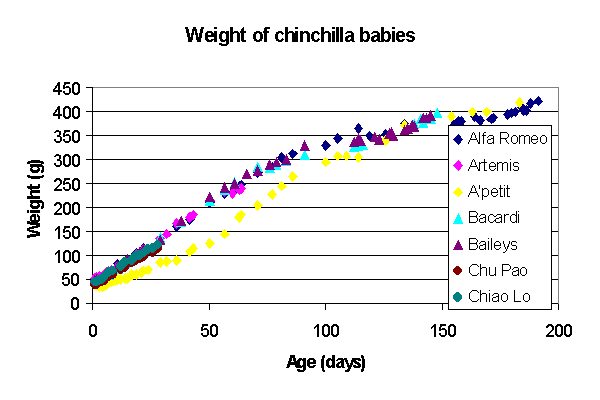 Source: Bettina Hansen
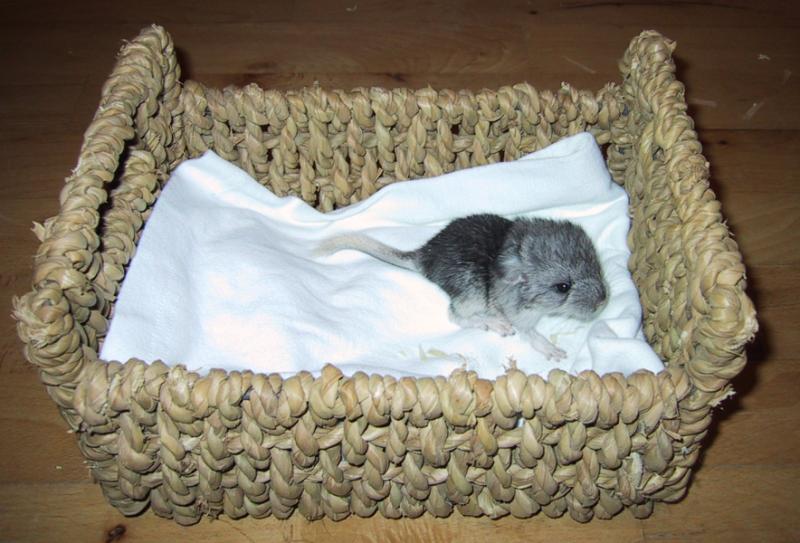
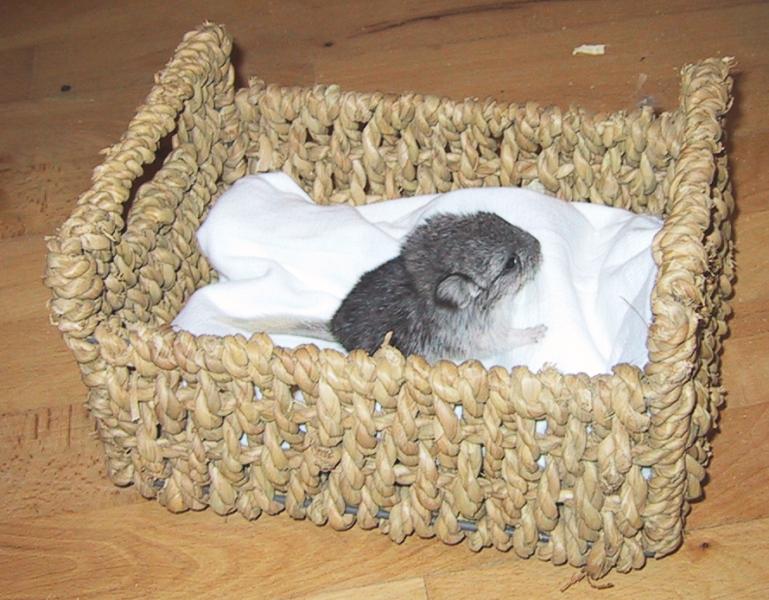
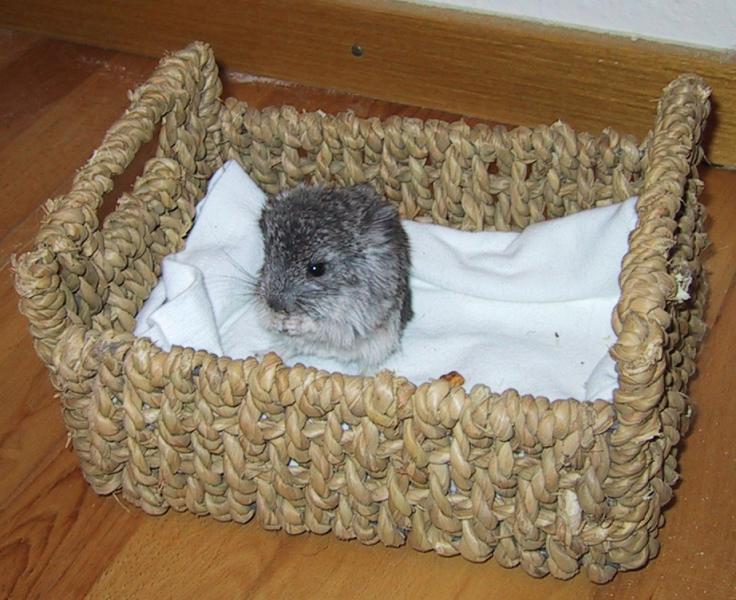
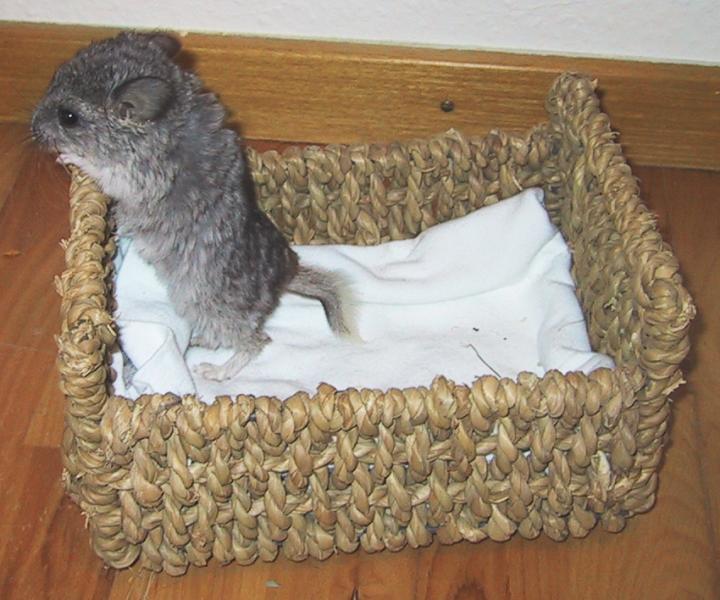
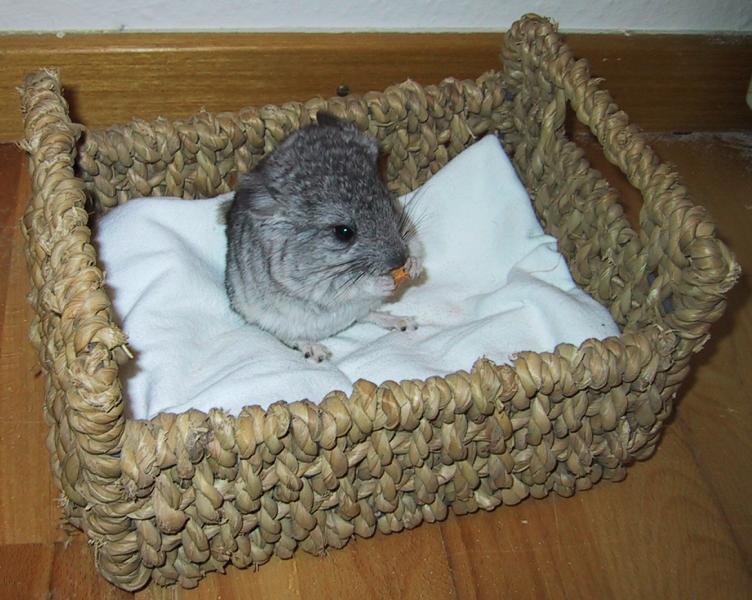
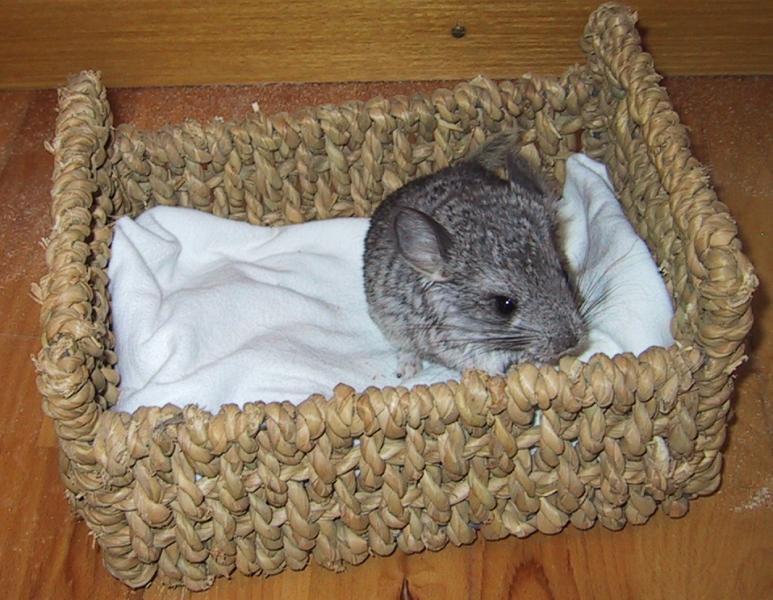
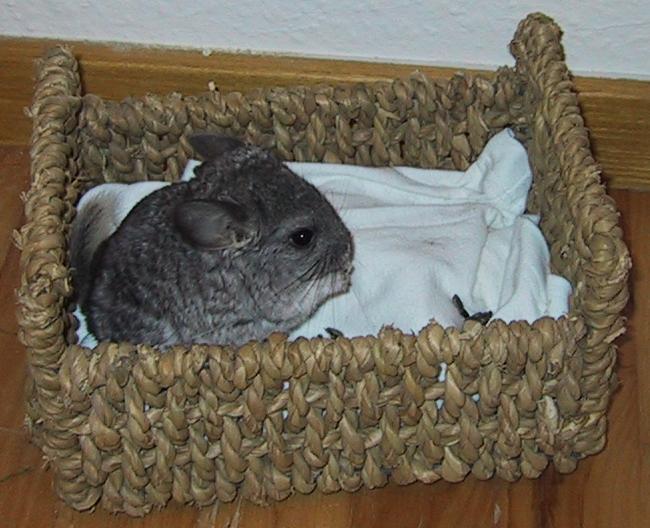
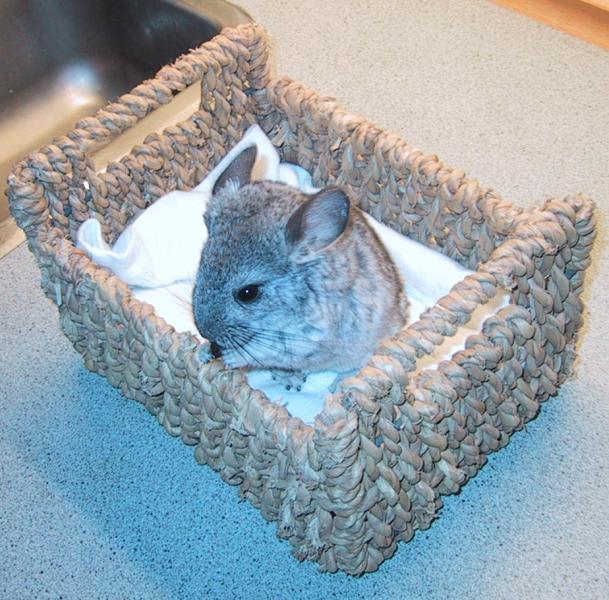
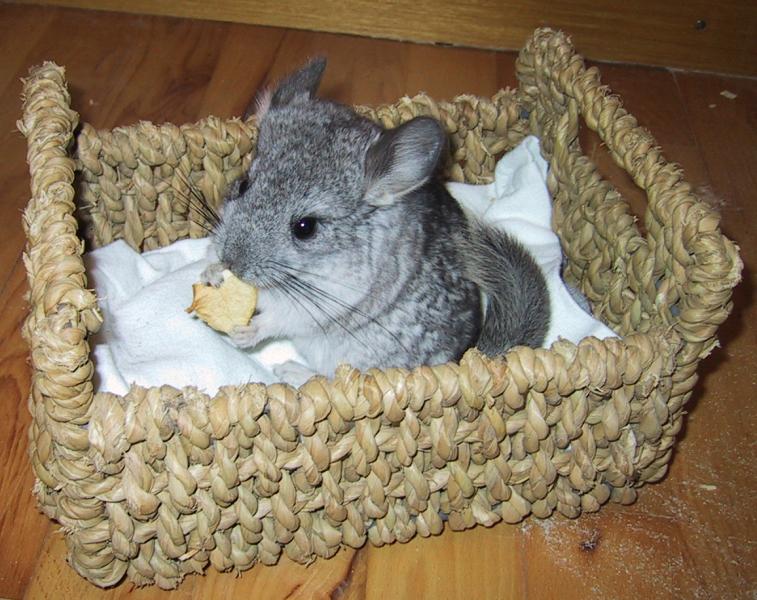
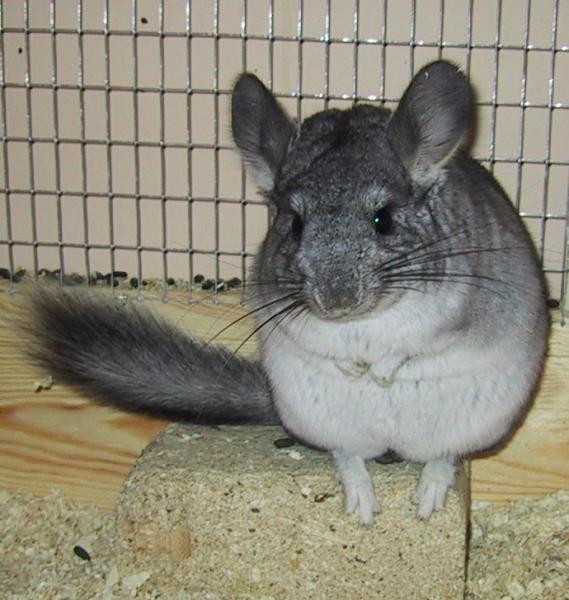
The following is a gallery of A'petit's appearance (and weight) at various ages:
 |
 |
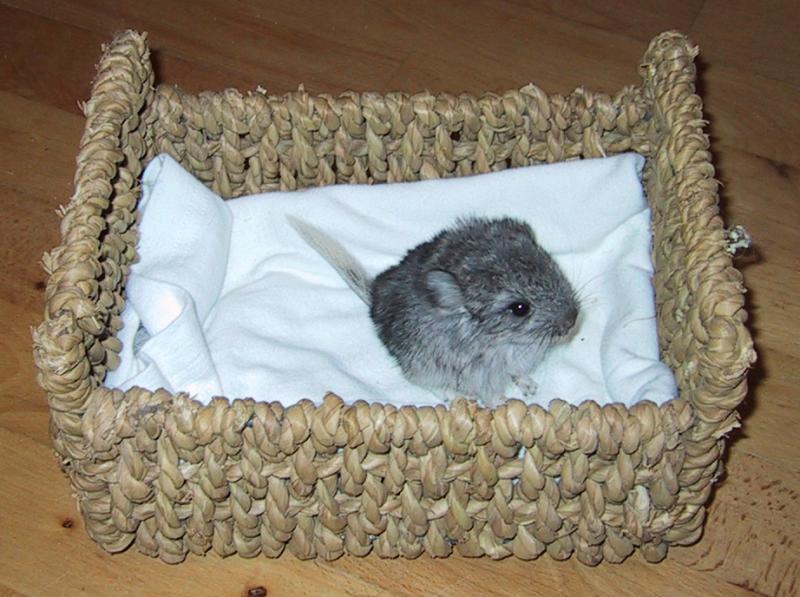 |
| Day 1 (40g) | Day 8 (44g) | Day 15 (52g) |
 |
 |
 |
| Day 22 (67 g) | Day 29 (85 g) | Day 36 (91 g) |
 |
 |
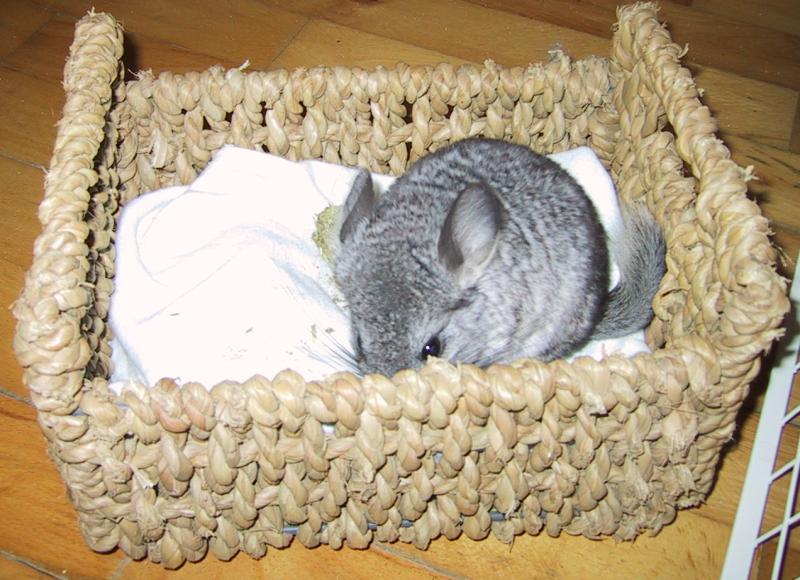 |
| Day 43 (110 g) | Day 50 (125 g) | Day 57 (146 g) |
 |
 |
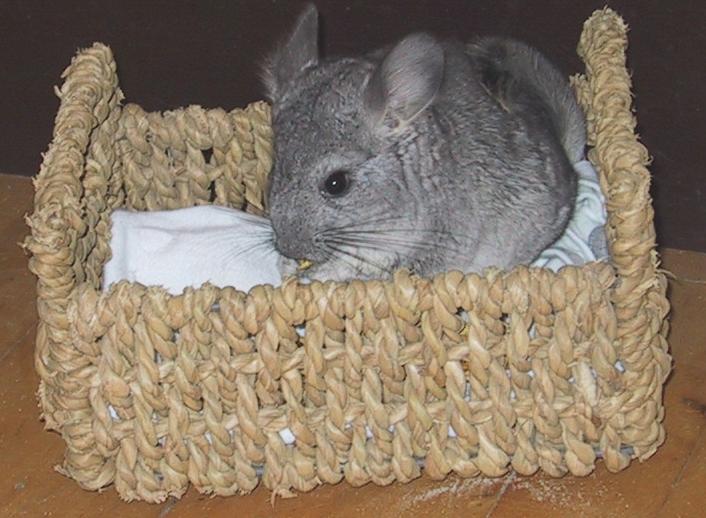 |
| Day 64 (186 g) | Day 71 (204 g) | Day 132 (305 g) |
 |
||
| ~6 months (~420 g) |
Raising Orphaned Young
If the mother dies you will have to either find a “wet nurse” for the kit or plan to hand raise him/her. A suitable wet nurse would be a chinchilla or guinea pig mother with only one kit of approximately the same age as the orphan. A good trick to try is to put mentholated ointment on the orphaned kit's back as well as on the new mom's natural kits so that they all smell the same. Watch the litter closely to make sure that the orphan is accepted. If not you need to hand raise them, an endeavor that is not always successful. For rearing milk try using KMR (available at pet stores, feed stores, and veterinary offices) or a product designed for feeding baby lambs. Newborns need to be fed warm rearing milk (freshly prepared) every two hours for the first two weeks, then every three hours. Gradually lengthen the feeding time and reduce the amounts fed until they can be weaned at 6 – 8 weeks. You can go a little longer with night time feedings, but not too much as these are their normal awake hours. I've found that an insulin syringe works better then an eyedropper for feeding newborns, then a 3 cc. syringe, then an eye dropper or regular water bottle as they get older. Hold the newborn cradled upright in your hand, making sure he doesn't choke and get milk in his lungs. After the feeding gently massage the tummy. Go ahead and provide hay and pellets for him to nibble on. I avoid providing a water bottle (with water in it) for at least the first few weeks so as to encourage a good feeding of milk. By 2 – 3 weeks of age you shouldn't need to hold the little guy in your hand anymore as he will sit upright for his feeding. You can also gradually add baby cereal to the milk.
Extra Food For Large Litters
If there are 3 – 4 kits in a litter the mother's milk may not be plentiful enough for them. If you don't help her with providing food for her young they may nip, bite, and injure her nipples in their struggle for milk. They may also become aggressively competitive with each other. You can supplement their feed in a manner similar to feeding orphans, but in smaller quantities and less frequently. It may also be advised to separate the kits into groups, removing one group for about 6 hours (and supplementing their feed) then rotating with the other group to give mom a break and prevent sibling rivalry. You may prefer a different schedule, like separating the groups for 8 hour segments (when older) then putting everyone together at night. You may want to give mom a time all to herself, allowing all of the kits to maintain some contact with each other, especially if you won't be keeping everyone together at night. See what works best for you and your family but keep in mind that the kits should only go for short periods without mom's milk when very young, then for longer periods as they get older. Also remember to weigh them frequently to determine whether or not they are gaining an adequate amount of weight, adjusting your schedule and supplement amounts accordingly (a lot depends upon the mom's milk supply).


 (4 votes, average: 3.50 out of 5)
 Loading...
if a mom rejects one of her babies should I take the baby out of the cage completely or leave it in there with her and continue the feedings. I haven't noticed any aggressive behavior she just is not feeding one of them
Please help I just lost my cat I don't want to lose another fur baby.
Hello,
I have a female and male as cage mates but the male was supposed to be sterile (had him for 4 years and her for 2.5 years). They have lived fine for 2 years then my girl Boof had a baby girl 2 days ago. I had nothing prepared and scrambled to remove levels, get dad out so he would stop trying to breed mom, wrap cage in mesh to shrink bar space and get a nesting box built. Baby fell through bottom level bar space and I instantly freaked the crap out! I am so nervous about how the baby is doing. I keep my house at 65ish degrees is that too cold for her? Mom is feeding cuddling and cleaning baby as well as eating well herself. Baby is scared of everything but mom doesn't mind if I touch or hold her baby, how do I help her not be scared of me? I have held her a few times and rubbed her chin and ear and she relaxed and yawned but runs away if I reach in for her. Also, if I have the door open to give mom Boof a treat, I have to pay very close attention or baby runs straight out of the cage; I caught her both times, is she blind? She also hops around the cage pretty fast but I don't think it is pop-corning, it looks more random and scared, I am worried. 😦 How can I tell if she is healthy and well fed? I can't find much on new born chin behavior and what I need to watch for, how I can make everything perfect and make sure she stays healthy and alive. Can you help?
My chinchilla gave birth a little over a week ago. She has one baby girl. The mom is continuing with her dust baths as normal but the baby still hasn't learned how to do it. The mom will not be in the bath with the baby. She is very shy and will only do it when completely alone. I can't even be in the room with her. I'm afraid that the baby is not learning how to bathe correctly. I put her in alone and try to rub the dust on her but she doesn't understand. Any tips? Can I have the father teach her? He has never been around her since the day she was born because of how aggressive he was with the mom after birth (he wanted to mate immediately and it pissed her off). I don't want him to be aggressive with the baby. Let me know if you have any suggestions for me. Thanks!
The baby should not dust bathe till it is at least two weeks old. I don't allow the mother to dust bathe till then either.
Don't worry.... It comes naturally to them.
Hi,
The man who sold us our chinnies said they were both boys but made a mistake, long story short we now have three bouncing baby chins. Mom and dad are both great parents and all the babies are doing well, I'm just nervous they are doing too well. We weigh them everyday and they gain about 3 to 4 grams a day! One day our biggest one gained 7!!! They are all really strong and active and haven't been lethargic at all, should,o be concerned about this rapid weight gain?
you should be giving them 2 ounces of water a day and 1-2 tablespoons of food a day. Have you been giving them more?
My female chin died 12 days after giving birth to a pair of babies. As I wanted to stabilise the babies , I sent them for a 10-day lodging with an old couples who have been supplying me the chinchillas and food since 10 yrs ago. I have the following questions and appreciate advices:
1. The babies were 43 grams each when they were born. About 3 days prior to the passing of their mommy they grew to 67 grams. Their weight dropped to 60/61 when mommy fell sick. After about a week of lodging the old couples claimed that they have been active but no gain in weight at all. They said babies are still getting use to the kitten milk so I don't have to worry about it. Is it normal for the weight to remain status quo for a week ?
2. When they are back after lodging (they would be 22 days old I intend to feed them every 2-3hours. How much milk powder to water ratio should I mixed, and how much milk per feeding session is enough ?
3. Can I put pre mixed milk in a cooler box (to bring them to work) ? How long can the milk keep fresh in the cooler box ?
4. When can I start weaning them off and at what speed of reduction of feeding ?
5 . Can I add Oxbow critical care powder to the milk ? If yes , how much to add ?
Sorry for the long message but I really need expert advice. Thank you.
Please help!
My female chinchilla just had three babies and I immediately separated the male from her. She seems to be doing good, she's eating and drinking fine. But it almost seems like she is ignoring the babies. They look like they are still damp and I'm afraid they will get hypothermia. They are all about the same size and were moving around, but it is late at night and they seem to be sleeping now.
Should I be concerned at all or let the mom do her thing?
just keep an eye on them, with 3 kits they may fight over her milk. My male kit drew blood on my female so I have to rotate the kits every 2 hours. 24 hours a day 7 days a week. Keep them warm, I'm using a heating pad and a cat carrier. Supplementing milk i use goat's milk and bottled water.
I have one baby chinchilla. He is 5 days old and already jumping on top of the hide away hut I was just wondering when the baby can start climbing on ramps and things? Aslo how can I keep him from eating his mother's food? He doesn't actually eat it yet but pick it up in his mouth and tries to?
No, don't stop him from eating her food. That's how they learn to eat hay and pellets. Kits are born perfect miniatures of your chins with teeth lol. They need to be able to chew on stuff too. No baths for kits or momma for at least 10 days. They need to be in a 1 level cage. They can get hurt jumping or falling off ramps or ledges. And the cage needs to have 1/2 in gaps or they can fit through and fall out.
We have a female chinchilla as a classroom pet. She was bred and has a 3 month old baby. I suspect she is pregnant again and will deliver soon. Should her baby be separated from her during this time. She seems to be bothered by the baby.
How irresponsible of you to allow the mother to get pregnant so soon after giving birth!
Emily, NancyNash had no control of her chinchilla getting pregnant again, it is a natural thing that all chinchilla's will do. I have 1 month and a half old kit and I suspect the mother got knocked up the same day she gave birth, it is just natural for them to do so.
The parents should have been separated both for preventing back breeding and for the birth. Natural behaviour is a given but it doesn't mean you should encourage that. What a toll that could take on her.
Having a chinchilla get pregnant right after giving birth could kill her. The kits are already taken a toll on her body by needing her milk, along with everything it took to give birth to them.
i didnt know my chinchilla was pregnant i didnt find a mating plug it was her first litter and because i didnt know she was expecting i didnt place a piece of carpetor card down .i noticed a small baby to my suprise wobbling aroundbut when i had a closer look in noticed the right back leg,right front leg and tail missing at first i thought it was deformed but soon realised wounds it lived for 2 days , she didnt seem to bother much with it but was still feeding it , what do u think happened as i dont want it to happen again ,thanks jox
Do u have mouse traps or a dog or cat that could have gotten at it and it escaped? Or sometimes if there is more then one kit sometimes the siblings are aggressive towards each other but idk if they could do what u described about the kit.
My chinchilla Sandy had her first litter of babies 8 days ago. Today two of the to babies are big and healthy, but the one is smaller (about 10 g less than others). It's gaining weight slowly and is active but is fighting or is being attacked by the other two. I don't see any blood being drawn but I still don't want them to fight. Were feeding the runt extra milk while its drinking some of moms milk. If they do fight I'll separate the two and let the smaller one with mom and the bigger one with dad for about a hour or less. What should I do to help stop the fighting? Please help soon!
Hello
I hope you can help... I have a mom and dad chin, Mom gave birth to 3 chins one month ago, The very tiny runt only made it a week and a half. Other two were doing fine.
until yesterday, one baby died.. Was doing great gaining weight playing etc..
and the mom dies today, with no sign of anything wrong... Im sick over this cant seem to figure out what could have happened?
FYI dad has been in another cage as soon as she had the babies, I just put him in with the only 1 month old kit. He is acting as if he is searching for mom... They have never been separated until she had babies, They were together for about a yr.
I feel so bad for him and now the kit as well... any help would be so appreciated
Please email me
Thank You !!
Cindy
You don't need to take the male away from the family once the babies are born. He actually helps her when she is giving birth and also with the babies when she is raising them. I took the dad away the first time I had a chinchilla have a litter and she killed the babies while crying the whole time. It was heartbreaking!
I have three chinchillas. ChiChi, the girl, Nico, the boy, and Gizmo, the baby. ChiChi and Nico had the baby boy on May seventh, approximately 30 days ago. I have ChiChi and Gizmo in the same cage so he could nurse and so ChiChi wouldn't get pregnant again. I am wondering when i should put Gizmo in the cage with his father so he won't get his mother pregnant. He has already started to try and mate with her and I'm scared that she will get depressed and stop eating or drinking if i remover him from her to early. Please when should i put Gizmo in the cage with Nico.
It is best to remove the male babies by 10 weeks of age so they don't breed the mom. He should be eating fine by than. To limit the stress of taking him out put the 2 cages next to each other so she can still see the baby and smell him. If Nico hasn't seen the baby or been around him do a trial run for a couple weeks during the day while you are watching to make sure he is fine with the baby. You can start during the day when the baby is about 6 weeks old to make sure he's eating okay. Just be sure to watch and see if Dad is too pushy when it comes to food. Do not leave the baby in with him until you know for sure Dad and baby are fine together.
Dear Alexis,
For starters the female is already stressing with the new baby. Also after giving birth chins can get pregnant again........ Your female should have a break from the male for 10-14 days. This will keep her and the baby healthy. No dust baths during that time as well.
One of my beautiful chins delivered 2 days ago. It's very obvious she misses him. She has her hands full with triplets. She's calmed down alot in 2 and a half days. I certainly wouldn't want her to become pregnant again it would take it's toll on her body and jeopardize the new babies. Trust what she wants and doesn't want. Hope this helps
Tracy
We had 3 babies born on Mar 24. Within a few hours the male was trying to breed her again. We had to put him into a separate cage. He was so unhappy in the other room, I finally moved his cage next to momma and the babies cage. He is a little happier.
The babies are hilarious to watch an momma is nicer to me than she has ever been. Although the first 3 days after having the kits she was not.
Still trying to decide on the sex of the babies. We also have to decide if there will be future babies or if someone is making a trip tothe vet so they can be together again.
Well today I woke up to two baby chinchillas. I was shocked because I was told that my two chinchillas were boys so I had no clue one was pregnant. Well she had a boy and a girl and the kits are attacking each other. Is that normal? If not what do I do?
Dear Brit, it is very normal for kits to do that they will be aggressive towards each other. But if one of them is smaller then the other I suggest try bottle feeding it to bring some of the fighting down a notch.
I guess Ive been lucky!! My female chin, Violet has had two litters over the past year. The father and Violet have their own room. So they have a lot of space. So when violet has given birth to the babies, she doesnt get aggresive with the father. But, she does get aggressive with the rabbit that I let out of the cage once in awhile. So I have kept the rabbit caged up so that Violet want get upset. But, what is so weird is the father is crazy over the rabbit. Almost more than he is over Violet. I got the rabbit for the father before I got Violet for him. He stands around the cage staring at the rabbit and gets depressed if I dont let the rabbit out. When I do let out the rabbit, he's jumping on top of the rabbit trying to mate with her. Is so funny to watch!! Anyway, I dont have issues with Violet and the father getting aggressive with each other even after birth. If you are having that problem, I would suggest to put the male in a separate cage for awhile until the babies are 2 months old. Im not an expert, but giving each chinchilla space may help....
Please help i woke up this morning (15/04/11) to find a dead tiny chinchilla on the cage floor, so got it out only to find a baby alive and well and much bigger!! I have only had my chinchillas for less than a month after recusing them and being told they were both Female and i never did check myself!! Any advise who be excellant on how to look after mum and baby!!
10 days ago my chinchilla gave birth to 3 babies, this was her first time. The first baby was fine, he was the strongest one. The second one was also fine but was quite thin (but active though). The third one looked very bad, especially his eyes. As I didn't have any problems with my previous chinchilla giving birth 3 times, I didn't know I have to take care of the babies, I thought the mom will do it by herself. Apparently not. The third baby got his eye infected so bad that he died this morning. And I looked at the second baby and he had the same infection in one of his eyes. I found out on the Internet that it is because of the sand, so I cleaned the cage and there is no sand anymore.
What else should I do to make the infection stop and the baby survived? And does it mean that none of the chinchillas can have a sand bath (even outside the cage)? I have 2 big chinchilla sisters + 2 babies.
They're supposed to take dust baths, not sand baths. It can injure them severely but they should be ok by now if you took the sand out, but you may want to get the little guy's infection checked out.
my chinchillas have been with eachother the whole lives and she just had a kit but for some reason she keeps attacking her mate pulling fur out and spraying him with urien so im getting scared because he become very deppressed and i let him see his baby and he fine with her but try putting dad and mom together in he same cage all hell breaks loose so is there any way she will accept her mate again or is this just a phase shes goin through because of the baby please help dont want to see anything eles happen to them any help would be great ty
Hi! It's probably best if for the time being if you put him in a seperate cage and then pushed them close enough together so that Dad can see the baby but Mom can't attack him through the bars. It's probably because either she is exhausted or is begging him not to get her pregnant again (I have seen this happen and the mother attacks the father like you described), and the dad either is trying to or not getting it at all. Also, Mom might not be recognizing him and/or not wanting him to harm the child. I think that if you wait until the kit is old enough, then put the kit in a seperate cage or sell her. Then try all over again with Mom and Dad!
My baby chinchilla will be 8 weeks old tomorrow, we are pretty sure she is a female, but i was just wondering if i have still have to removed baby from parents to be weaned properly or is it ok for her to stay with them? She is eating and drinking well and dad has been neutered.
I have female chinchilla who is super sweet and we play with her all the time. I want a male so we can breed her. They are almost impossible to find where I live. Can I breed her with chinchill from the same parents but from a different litter? I know you can't breed them with one that is their litter mate but wasn't sure about if it would make a difference coming from a different litter.
thanks
My chinchilla had babies a week ago.. and sadly died 3 days later, she was an amazing, beautiful, sweet chinchilla and it was her 1st litter, and she had 2 babies, which I heard is a big litter for a 1st time mom, though thats not the cause of death, (it turned out to be a disease from her kidney) the vet said there was nothing we could have done about it.. my point is, is that I'm still mourning her death, so could the babies mourn also? Because they are very sleepy now, but when she was alive they ran around the cage and were very active. I'm bottle feeding them every 2 hours during the day, and every 3 at night. they don't seem to be gaining good weight.. and they don't eat very much at all. I feed them with a very small bottle and I used KMR at first but thats expensive so I switched to a catmilk brand that I heard was better from a friend/breeder. I carry them around in the pocket of my hoodie when I'm at home to make sure their warm and they get used to sounds, smells and most importantly people, for about 2 hours.. could this be seriously affecting their health? Also.. sorry this is a long message, their are 2 possible dads.. should I leave it up to the potential fathers to figure out the maternity mystery when the kits are old enough? or will both males take care of the babies either way? I also am wondering whether I should give them to my friend who I said would before the mom passed away, who now says they understand if I want to keep them.. Which I want to.. or sell them to a hobby breeder who sold me the dads? The babies are rare colors(so I've been told), and very beautiful.. and I could get alot of money for them.. but I am also considering keeping and breeding them in a couple years.. what should I do?
I'm sorry to hear about this. It must be very upsetting. The chinchilla kits are probably missing their mother, yes. As hard as you try, you'll never quite be able to live up to the furry, bundle of chinchilla that they as their mom.
Well done with your bottle feeding. I'm glad you didn't just neglect them! I know how tiring it is so well done.
That's a very confusing problem. It all depends who mated with the mother. If they both did, then who knows. If one mated with her, then he'll probably act more fathery to the little kits. But please, don't put them together if the kits are females... the dad will mate with them.
What are the 'rare colors'?? Look it up. If they are Violet or Sapphire, you may want to consider selling just one and keeping it to breed. If they are Ebony, don't bother. Just sell them. People go over the top about how rare they are, but frankly, they seem to turn up more often than Standards and I don't own any Ebonies!! And finally, if they are Goldbar, for god's sake keep them. Just please. Breed them. You'll understand why if you look it up.
Anything else is not very rare. Keep them if you want as a connection to the mum.
They need goats milk.
My chinchillas just had babies. We were told they were both male but apparently not. How do we care for them? Im particularly concerned about water.....will they be able to drink for the standard water bottle that they adults use?
As for the water, not right now. For the first couple of weeks, keep them with mom and let them drink from her. Gradually ween them and separate any male kit at about four months old, because he'll start to breed. Yes, when they grow up they can drink from the same bottle.
My chinchilla just had a litter today, I thought both chinchillas were boys, turns out one was a girl. I had as certificate from PETCO that said that my chinchilla was a boy, they were obviously wrong. Kwanye had a litter of 4 kits but one was still born. I had no idea my chinchillas was a girl, much less pregnant. I woke up and was having my daily coffee when i noticed some little things moving in the cage, to my surprise, BABY CHINCHILLAS!!!
I noticed that it seemed like the mother was protecting her children as she seemed to be aggressive towards the dad so i separated them. The mother is taking care of the babies just fine. My partner said he saw the chinchilla father trying to go downstairs in the cage to see the babies. But i am scared that he might attack the babies since the mother seemed to be blocking the stairs to the lower part of the cage, I do not know what do do. I do not want to separate the family but i want the babies to be safe.
I read somewhere that if the mom chinchilla gets stressed out, she will kill her kits? So now i am really panicking.
The cage is immaculately clean, its in a warm place free of drafts and cold, fresh water fot the mom, pellets, hay, a little house for the mom to take care of her babies in. Am i doing things correctly? Im freaked out that they might not make it, im reading as much as i can on the internet as this is a complete surprise to me, it really shocked me.
Any advice?
the mother wont kill the kits because chinchillas make good mothers, but it would be best to separate the other chinchillas from the mother and babys until the babys are bigger
First please don't trust everything you read on the internet. Mom and babies need to be in a baby safe cage with fresh water, timothy hay and alfafa hay. Babies should be weighed daily to make sure they are gaining daily.
My friend's chinchilla just had babies about a month ago. He is going to give me one, but we aren't sure when the little guy can leave its mother. How soon can a baby chinchilla leave its mother and be on its own?
The kit can be weaned at 4 months, while the breeder is sill keeping it in a different cage for a week or two to make sure that it is eating well. I suggest to read up and study on chinchillas.... they can be a big responsibility.
Hope I helped!:]
By 4 months the male chins can get their mother pregnant. Chins should be removed from the mother around 10 weeks if eating and drinking and at least 200 grams.
I recently have had 3 babies by Molly (1 Sep 10) and Hannah had one (so far) this morning (14 Sep 10). I seperated the two of Mommas. This is Hannahs first and last litter. Molly has had 2 other litters. I found the Dad a home with the two other males of Molly's but it was too late. How far apart will a chinchilla have her babies? is it an all day process? Hannahs baby is kinda small. molly had three and they have been bickering over Molly. Would it be a good idea to put Molly's runt in with Hannah and her new baby? I also need to find home for any of these that are male. I had a hard time finding a safe place for the other males. Any suggestions. I really want a good home for the babies. I will keep any females we have. I have a large Critter Nation cage and plan on adding another addition. Thanks for any help,
v/r,
Jen
Hi. My chinchilla had babies about a week and a half ago. She had 4. One was dead when we went down there and found babies. And also one was clinging on to life. We tried feeding it kitten milk being as that is what petco told us to get buy he didn't survive. He choked. Mom was ignoring him as well. What should I do about that if that ever happens again. And also the mom is very vicious towards the other two adult chins. Ones the dad and ones a girl that we purchased after them but they always fight. Whether if on of them is in the cage. The mom would stl try and attack the two. What shoul I do about that. Cause the mom chinchilla had a huge cut on her nose. It was a bad sight. But the babies are good. One is smaller than the other.
My chinchilla just had two precious babies!!! I am so excited I've been waiting for this for this for years! But the female is being EXTREMELY aggressive towards the male who is now in a pet carrier ad free in my room. Any tips?
Hello (muffin) you should face the pet carrier torwards the female/babbies cage and put it as close to the cage as possible without the mom being able to bite dad. This will let them see eachother and get used to eachothers appearance and smell. Soon mom will take to dad after she is done being overly protective and then you can put them together again... If this doesnt take you can put the baby with dad for 10 minutes but (CLOSELY WATCH!!) If he shows any agression sepprate them and try again in afew days. Good luck is anymore questions email me at hallanissa@rocketmail.com
Hi,
If the mom is being agressive towards the dad chinchilla you need to provide acommidation next to the mom and the kits so the dad can still see what is going on in the cage. If you dont do this, When you seperate mom and kits to put the dad back the two perants with most probable fight each other. It is very comman for the mom to become aggressve and protective for there young. Hope this helps ;-)
leave the mom to it if you have any problems let me know where you if, my female might wet nurse if your local, make sure shes not near to much noise and different smells, you can normally handle the babys about an hour after been born but if shes very over protective just feed and water her and leave her two it!!! dont breed her off again if shes like this if she gets stressed out she may kill it, i wouldnt keep the baby either because she'll be the same with the baby through out its life. x
hi everyone, i just bought a chinchilla and she was pregnant, i did not know until i checked her and to my suprise there was a little one moving around the cage, is there anything i need to do? mom is very protective of it,she comes running at the cage and making a snorting/ spitting sound when i go near the cage but i just talk to her.should i just leave her for awhile?any help greatly appreciated as i have no clue what to do. thanks
Try to give mom treats and keep her busy just for a split second and grab the baby gently and as fast as possible. Remember if you want good babys they have to be hand tammed to be sold or adopted out.
*maybe you and your female dont have a real tight bond cause the second my female chinchilla gave birth she let me grab the baby and dry it off.
any questions email me at hallanissa@rocketmail.com
Is the baby dead? Have you tried stimulating it, if you get a cloth and microwave It to warm temp not hot. Then put the baby in the cloth and loosely masage the baby sometimes that can bring dead looking babies back to contiousness
The mother chinchilla should look after her babies just fine by herself, however if there is one smaller than the other I strongly recomend weighing the chinchilla on a jewelry scale or something that weighs in grams. That way you can see if they are getting enough nutrients, and you'll be able to tell If mother is caring for it. It isn't realy in chinchillas nature to react to her babies violently or to abandon them. Mother is the best thing for the kits. But if she isn't feeding one of the kits or all of them, try to figure out why. Look it over and see if it is fully developed or if there is any deformations, like my grey has a very large head compared to his body. This is an animal that should never b bred. I'm going to keep all3 of my chinchillas but, the boys in one cage coco in another. If you do have to take a chinchilla away from mom due to it's life being threatened, get a heating pad set on low heat and put towels between it and the basin, Tupperware, or aquarium or whatever you are going to keep it in. Make sure it has fresh air, don't use any solid lids for tops use very small cage wire for top, and don't let baby chinchilla get hot it'll have heatstroke. The heat should only replace mothers body heat. And feed it warm formula every 2 hours, stimulate it's genitals for bowel movements w warm water and cotton swab
Hello Everyone, My family has decided to try our hand at breeding. Although we met an expert while living in California, we have now moved to Alabama, and don't know one here. We have 2 females and one male. The 2 females have given birth. The first one had 3 kits a week ago, but one of them did't make it, but the toher 2 are doing well and she took to motherhood right away. The other female gve birth yesterday to 1 enormous kit which seems fine. Our problem is, unlike the first mother chin this one seems uninterested in caringfor her baby. How long before we should be concerned? and if she never shows any "maternal instincts" should we move the kit in with mother#1?
My chinchilla coco had her 2 babies 3 weeks ago. On day 3 I heard some screams comming from the cage and ran to see what was wrong. Coco was chewing on the small grey chinchillas head. I grabbed it out real fast. There was so much blood I didn't know how such a small animal could live. I called a breeder from California and he said this behavior can only b explained by mayb ther being genetic problems with the baby. I'm not a breeder, I got coco thinking she was3 months old, clearly she's not. But anyways the breeder from Cali gave me some great advise . He said Never to breed the baby chin, keep him warm and use a formula and eye dropper or a syrenge to feed it every 2 hours. My little grey chinchilla is doing fine now@ 3 weeks old. I preffered instead of carnation milk, I used infant soymilk called prosobee. I also noticed differences in the other baby chinchilla and in the little grey chin,the grey hadn't developed as fast as it's brother, his ears weren't open, he's 1/3 of the size of his brother. These development factors may b y your chinchillas are doing what my coco tried to do.
My chinchilla had a baby this morning. Then I checked a little while ago and there is another baby and this one is dead. Should I take it out of the cage.
My chinchilla had a baby too. I didn't even know she was pregnant until yesterday I looked in the cage and saw blood and the the mother (Bella) moved and there was a little baby running around. He is so cute I went to feed them last night and couldn't find the baby (Damon) the daddy (Stafan) was in there and so was Bella. We looked everywhere and finally found Damon. He ended up excaping twice last night, so we had to "baby proof" the cage so the baby wouldn't get out and luckily he hasnt figured it out yet. They are a lot to care for but they are amazing creatures. :)
HELP!!!!!!!!!!!!!! I have had problems where my chinchillas have babies but then after a while they are killed off. Which chinchillas would do this, what age, and why ?
Mama and kits shud be seperated from Papa in another cage immediately and Mama shud be given special care such as extra food , vitamine etc (look at feeding). Then she in good health to take care of kits.
Cage must be of small wire as kits might run off. Lay papers at bottom of new cage. Mama and kits must be together for about 3-5 mths until kits can be on their own. Then Mama send back to Papa.
Help needed !!. my female chinchilla has gave birth to 2 babies lastnight and i do not have a clue how to look after them plz help thanks
Well you need to make sure they can't get out of the cage. My chinchilla had babies and I didn't know she was even pregnant I bought her that way. Well the cage I had for her was for chinchilla's and was bought from petsmart and well both babies got out and thank god I found them and they were only 7 days old. The mother chinchilla does everything herself I haven't had to help out at all.
hi i wonder if anyone can help me i have a male and female chinchillas and the female has had 3 litters since i bought her and none of the kits have survived she seems to be killing them straight away. does anyone know the cause of this please, she has just recently had a litter and i had to remove 1 that she had started eating on the neck
Hi i bought 2 female chinchillas so i thought i went on holiday 1 chinchilla had 2 kits now when i go to play and feed them there all happy 2 c us im worried tho cos i dnt see mum feedin all the time shud i go 2 a vet or is it normal they r about 3 n a half weeks old becos i wasng present at birth i didnt no how small they were plz help thanks adele
DAVID: as soon as the female gives birth she will bleed and will have a "season" which means backbreeding, which is very stressfull and can cause womb infections ect... thats also why you should take the sand bath out of the cage while the kits are running about and your female is still bleeding!!
KATE: as i said to David she'll will have some sort of "season" after giving her, weather its fake or not... he's welcome to go back in the cage with your female and kits about 14 days after as females do bleed up too 10days depending on the litter size!
ALSO TO THE INFORMATION GIVEN ON THIS WEBSITE! CHINCHILLAS SHOULD NOT GET WET!!! HAS IT CAN KILL THEM!
Please remebered to take dad out of he cage for a week to 10 days after, or better yet, before the birth, to prevent breedback. Breedbacks are extremely tiring on mom, and there have been times when the mom has died from exaustion.
Ok, I am completely caught unaware. The Chinchillas were purchased by my girlfriend and she was told she bought 2 females. We have had them for about a month now. I go to the cage to feed them like I do daily and I see a baby in the cage (just one is that normal because I see info on liters). The baby has climbed the cage and the mom and (dad?) are eating. How often does the baby feed off the mom cause now I sense that I should stay up to make sure everything is ok
our chinchillas have just had a baby on monday. and i have put dad in a cage just next to mum and baby, only because as soon as i put them together after teh birth, the dad got a little frisky
how do you tell what sex my chinchilla is and its approximate age?
both sexes have the same external anatomy, the way you tell the difference is the female bits doesnt have a gap between what looks like a penis and her bum, where as the male has a slight gap between what is a penis and its bum. if you google it, it might show you a picture, I thought I had two males up untill we found a baby in the cage, then we realised that although they both had the same anatomy, it was the slight gap that one of them had that made the difference, I dont know how you tell the age, probably by size, if you google images of different age chinchillas and compare yours to it should get a rough idea. good luck
hi, i have got 2females n 1 male all in 1 cage,tey live in my shed outside n went 2feed them this mornin n found some kits,she has had 4kits n 1off them has been rejected by her mother, i have removed mum n the kits out n put them in a cat carrier 4now but i have had 2remove the kits that wasnt feedin off mum,ive had a look on internet 2see wat i have 2give wen hand rearin n im not quite sure,was wonderin if anybody knows n if they could tell me, i do know i have 2 feed the kit every 2hours but i dont know wat n how much,please could somebody help me.xx
i have a book that says either kitten milk from a pet store, or 1 part cows milk with 2 parts water, or 1 part evaporated milk with 2 parts water ( cooled boiled water though) if hand rearing need to gently rub the belly afterwards with your finger as if the mum was licking the baby to stimulate digestion, and keep the kits eyes clean . with cotton buds and coled boiled water, it says that kits rarely survive hand rearing, and keeping it warm is a big must. so if you have straw, and a cuddley toy for it to snuggle up to and a heat lamp or heat mat that wil up the chances, it also says to keep trying re introducing the kit, they dont usually reject there kits but if they have a litter of more than 2 kits, then the mum can be overwhelmed and exhaust easily. good luck.
i have two kits that were just born,but they both have one fully opened eye and the other eye is not.do you think it is normal.
mine had this, i just gently opened the eye by applying a little pressure on the eye lids, and then gave them a clean with some boiled water and a cotton bud, it says if you leave the eye closed for more than 12 hours then you risk an infection build up.
i have a male and female chinchilla and two healthy kits which live outs side in a warmed hutch but i was wondering if they will be ok out there with the mom and dad as i have never bred themmy chinchillas before?
I hav 2 chinchillas, i cannot tell if they ar male or female, the lady in the pet shop wher i bought them didnt no anything about them, How can i tell the difference????
I have a male and female,and i realized a few weeks ago she was bigger, and today i went to clean their cage, and I found a dead baby kit. This really concerns me and I was wondering if she possibly could have another baby on the way. Im assuming the baby was killed by the father. I didn't know she was pregnate.
the same happened to me, I have a male and female homo beige chinchilla , the female got bigger and started to eat more food, and make cute noises, I didnt even consider that she could be pregnant, then about a week after this started, I found a dead kit in the cage which was devastating, when I looked at the female she was eating the after birth, when I moved her I found a live baby hiding under her, it was all wet with its eyes closed so it had only just been born, this was only yesterday and Ive been stressed all night wondering whether the baby is feeding ok, cos it doesnt seem to latch on for very long, I ended up blocking the upper levels to the cage to stop the baby climbing and then falling, and I filled the base with straw to stop his feet getting stuck in the grated base, and to keep him warm. I also took the dust bath away as aparently this can cause a womb infection to the mum within the first 10 days of birth. I keep the dad with the mum and baby through the day when I can supervise them, as the mum is apparently very fertile for the first 7 days after birth, so the male gets taken away over night, which makes me feel bad but I dont want her to fall pregnant again. the mum and dad are really good with the baby, on reading stories online its not uncomman for first time mums to encounter a still birth, I dont think my male had anything to do with the other baby kits death, plus the dad did not have any blood on him at all, and yet the female was covered in blood from giving birth and cleaning the baby afterwards. I have handled the baby a few times, to check its belly for milk, and to aid it to latch on to the mum to stimulate milk production, which seemed to work. and also I had to clean his eyes as they were stuck closed for over 12 hours. my female is 2 years old and this is her first pregnancy, the baby is making loads of cute noises, runs around, fully formed and has his eyes wide open now, but they say if they dont feed within the first 24 hours they probably wont last a week. so this worries me a little, but my husband thinks im just paranoid.
My chinchilla just had a baby.
it died i guess giving birth to another one so we will have to hand raise it.
wish me good luck.
My Chin just had babies last night. A litter of 3. Two of them are really good sized but sadly there is a runt. Cute as a button. However the runt is not nursing good from mom and i've tried hand feeding.....and he's eating a little, but not much.....any suggestions on how to get him to eat better????
Thanks
Your site helped out a lot! My chinchillas just had a baby today, and I couldnt find any info on how to help my mom care for the baby! Your site is great! Thanks a lot.
if you have 3 or 4 kits in a litter but there are too many what would you do ????
thank you
p.s i am nervous about having a litter does it usualy go to plan???
x
Also once adults make sure they arn't to warm because they can over heat.
that is good info except that even though they can get hypothermia you really should not ever submerge them in water because that is very dangerous for them since water can kill them.
i've had two litters of baby chins, and my momma chinchilla is fiercely protective. not only does she growl and bark, but she lunges at strangers and bites them hard if they come near her kits! perhaps give her a treat as you open the cage door to look at them, i'm sure she'll let you handle the kits in time. my momma is really good at taking care of her babies, so i've never had to intervene. it sounds like yours is quite a competent mother as well. just make sure that all the kits look lively and happy, and that they're growing at a steady rate for the first month. i think the most important thing is keeping them in the cage and dry, as they're quite wiggly and can jump and fall into toilet bowls, etc, if they get out.
We just had 2 baby's unexpectedly. Can I give her extra raisins? And whenever I look around and open the cage door (the 3 chichillas are separted from the momy and babies)- she like gawks or barks at me or something like that. Help?
-Bekah
P.S- I have never had babies so I don't really know what to do,but i've been reading a little bit online. Any advice?
Thomas,
That's good news (we hope)! Unfortunately baby chinchillas are out of our realm of experience. We've only had weened chinchillas and so our experience is limited i.e. only from books.
- Ensure the cage wires are narrow enough so the baby cannot squeeze through.
- Move the male to another cage to give mom and baby space (and until you get the male neutered).
- Research if female chinchillas may benefit from a special diet (although that may be during pregnancy and not after).
- Take some pictures!
Some other sites to look at include:
- http://www.cheekychinchillas.com/breeding.html
- http://www.azure-chinchillas.co.uk/breeding-chinchillas/caring-for-litters
Good luck!
My wife just called me with the news that we have a baby chinchilla! We hadn't planned on it and had actually planned to get the male neutered. Guess not soon enough. So here I am searching the web for information on what we should do, watch for, etc. with our new baby chinchilla. It is walking around and everything already.
Rob,
Pictures speak loader than words with questions like yours. Unfortunately, we don't have any photos to help you with the identification process. However, check out this page which seems to provide the information you need.
http://www.huggablepets.com/huggablepets/sexing.shtml
How do you tell the difference between the males and females?